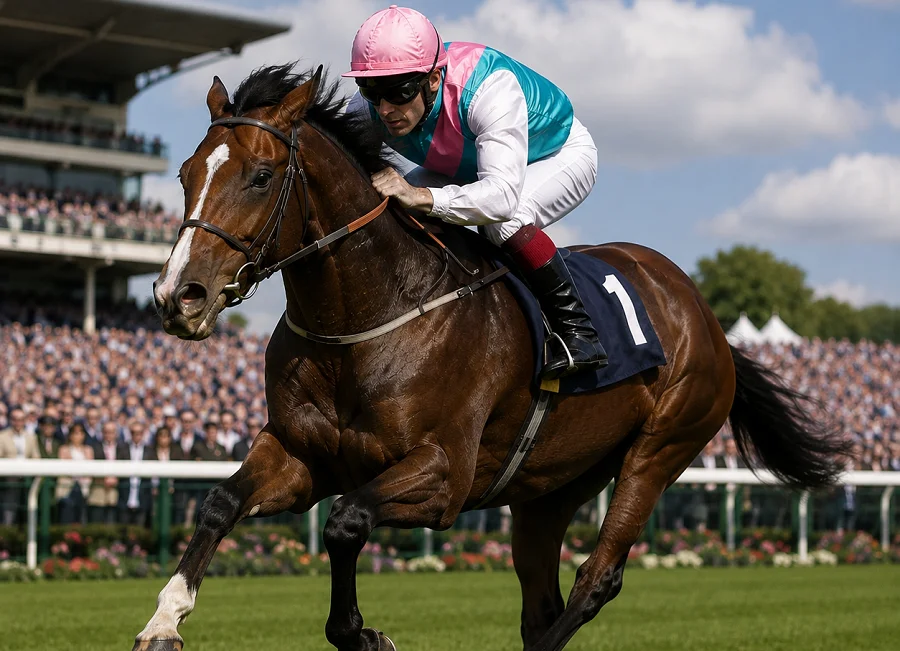
Every serious racing fan has, at some point, tried to answer the same question: how do you tell a genuinely exceptional horse apart from one simply enjoying a fortunate run against weak opposition? Frankel’s career offers the clearest possible answer, because his fourteen-race unbeaten record was not built on avoiding tough tests. It was built on demolishing the toughest fields European racing could assemble, repeatedly, by margins that made the rest of the field look like they were competing in a different event entirely. This article breaks down what actually made Frankel statistically extraordinary, and what punters can genuinely learn from his record about telling real dominance apart from a lucky streak.
The numbers behind the legend
Frankel retired in 2012 with a perfect record of fourteen wins from fourteen starts, ten of them at the highest Group 1 level. He received a final Timeform rating of 147, the highest mark ever awarded to a Flat racehorse, a figure that has never been matched or approached since he left the track. Perhaps the single most telling statistic from his career is the average winning distance across all fourteen races: 5.4 lengths, roughly forty-three feet, which meant that even in victory, Frankel was rarely seriously challenged by anything behind him.
Why margin of victory matters more than the win itself
For punters trying to distinguish genuine dominance from a favourable draw or a weak field, margin of victory is one of the most reliable signals available, and Frankel’s career illustrates exactly why. Winning a race by a head tells you a horse was good enough on the day. Winning by six lengths in the 2000 Guineas, or by eleven lengths in the Queen Anne Stakes against a genuinely high-class field, tells you something considerably more significant about the actual gap in ability between that horse and the rest of the field. Frankel’s wins were not narrow escapes stitched together into an unbeaten run; they were routine demonstrations of a horse operating in an entirely different tier from his rivals.
The quality of opposition he actually beat
A perfect record against weak fields tells punters very little. Frankel’s record is significant specifically because of who he beat: across his career, he defeated twenty-three different Group 1 winners by a cumulative winning distance of over seventy-six lengths. This detail matters enormously for anyone trying to assess a horse’s true quality, since it demonstrates that Frankel was not simply avoiding strong competition on his way to an unbeaten record. He was routinely facing established Group 1 winning horses and beating them comfortably, race after race, which is a considerably more meaningful signal of genuine class than an unbeaten record built against modest opposition ever could be.
Versatility across distance and ground conditions
Another mark of genuine dominance, as opposed to a horse simply suited to narrow, favourable conditions, is versatility. Frankel won across distances ranging from seven furlongs to a mile and two and a half furlongs, and he excelled on going that ranged from good to firm to soft. Punters assessing any horse’s credentials should pay close attention to this kind of range, since a horse that only performs well under one very specific set of conditions is a considerably riskier betting proposition than one that has demonstrated it can win regardless of distance or ground.
The one moment his class was seriously tested
Even a career as dominant as Frankel’s included at least one race where his ability was genuinely, visibly tested rather than comfortably demonstrated. His second start as a two-year-old saw only two other runners line up against him, largely because his sheer physical presence and reputation had already scared off potential rivals before the race even began, itself a fascinating signal of how markets and rival connections respond to genuinely dominant form. For punters, this illustrates an important lesson: sometimes the strongest evidence of class is not a race itself but how the market and rival trainers react in anticipation of a horse’s participation.
What separates true dominance from a hot run of form
The clearest lesson for punters from Frankel’s career is that genuine dominance shows up consistently across several dimensions at once: wide winning margins, high-quality opposition, and performance across varied conditions and distances. A horse enjoying a lucky run of form might show one or two of these signals in isolation, a single big win, a lucky trip, a soft field, but rarely all three sustained across an entire career. When assessing whether a currently unbeaten horse is the real thing or simply riding a wave of favourable circumstances, checking for this same combination of signals, rather than looking at the win-loss record alone, gives a far more reliable read on genuine ability.
Applying this lesson to modern racing analysis
These principles remain directly useful for anyone following horse racing betting today. Before backing a horse purely on the strength of an unbeaten streak, it is worth asking the same questions Frankel’s record answers so emphatically: how strong was the opposition actually beaten, by what margin, and across what range of conditions and distances? A horse ticking all three boxes deserves genuine respect in the betting market. A horse with an unbeaten record built on none of them is a considerably less reliable proposition, however impressive the raw win total looks on paper.
Where to explore other racing themed entertainment
For racing enthusiasts who enjoy the sport’s history and want to explore themed entertainment between meetings, an online casino such as sambaslots casino offers a lively selection of slots and table games worth a look during the quieter stretches of the racing calendar, when the next big meeting still feels a while away.
Setting a sensible approach to betting analysis
Whatever method you use to assess a horse’s genuine ability, whether studying margins, opposition quality or ground versatility, it is worth pairing careful analysis with equally careful bankroll management. Decide on a fixed betting budget before a race meeting begins, and treat that limit as seriously as you would treat any other planned expense, regardless of how confident your analysis makes you feel about a particular selection.
Responsible betting for racing enthusiasts
Racing has always rewarded patience and honest assessment over impulsive, emotionally driven decisions, both from trainers managing a horse’s career and from punters managing their own betting bank. Bringing that same discipline to your own betting means setting firm limits before you begin and treating any win as a pleasant outcome rather than an expectation. If betting ever starts to feel difficult to control, free and confidential support is available. Citizens Advice offers guidance on gambling-related concerns alongside broader support for anyone affected by the financial or practical fallout, available to anyone in the UK.
Conclusion
Frankel’s fourteen-race unbeaten record remains the clearest case study racing has ever produced for what genuine, sustained dominance actually looks like: not narrow wins against weak fields, but comfortable, repeated victories over genuine Group 1 class opposition, across varied distances and ground conditions, by margins that left no room for doubt. For punters, the lesson is straightforward even if applying it takes discipline: look past the simple win total, and check whether a horse’s record shows the same combination of signals that made Frankel’s career the standard every subsequent contender has been measured against.